
How Do You “Do” Community?
- Posted on JunpmMon, 06 Jun 2016 23:02:31 -05002016-06-06T23:02:31-05:0011 17, 2016
- in Bamidbar, Bible, God, Hebrew, Messiah, Study, Torah, Yeshua
- by Hallelujah Girl


How does one function in a community? As an individual member of a group of people living together. Even that new family that just moved in, they are welcome! In fact the new family is even more honorable than the ones that have lived in the community for years. Think, do you still live in the same community your grandparents did? Not many do. With technology we stay connected to our friends and families different than our parents and grandparents did. We now seem to have a different sense of what community is in the world today. In other words, todays generation may learn better how to live in a “Facebook” or “Twitter” community than the very area they live and sleep.
Being a part of a community and how we function in that community is exactly what we can learn from the book of Bamidbar (Numbers). Bamidbar translates to English, “In the Wilderness”. The Septuagint named the book “Numbers”. It does, in fact, contain a lot of numbers. What is it about these numbers? What are they to teach us? Let’s look a little closer at the word picture for this parashah’s title Bamidbar (במדבר ). The beit, ב, represents a tent, house, the body, the household, family, inside, within, and amid. The mem(מ) represents water, flowing water, or to come from. The dalet(ד), a door, a path, a way of life, or movement. Another beit(ב), then a reysh(ר), representing the head, person, what is highest, most important, or chief. Putting the letters together, one might see, “To each household, rivers of living water will move throughout each member of the body from the most important source.
Parashah Bamidbar (In the Wilderness) begins at Bamidbar (Numbers) 1:1 and finishes up at 4:20. The Haftarah portion is found in Hosea 2:1–22 in your Hebrew bible and in the English translations it is Hosea 1:10-20. The Gospel portion is from Luke chapter 16, verse 1 through chapter 17, verse 10.
“HASHEM spoke to Moses (Bamidbar) in the Wilderness of Sinai, in the Tent of Meeting, on the first day of the second month, in the second year after their exodus from the land of Egypt, saying: ’Take a census of the entire assembly of the Children of Israel according to their families, according to their fathers’ household, by number of the names, every male according to their head count.’” ~Bamidbar (Numbers) 1:1-2
Why does Torah present such a detailed census? And why do we need to know this? Every word of the Torah has a message, every jot and tittle. When we communicate a message, what we communicate depends greatly on how we deliver it. How we deliver a message is actually part of the message itself. This is what is happening here in the beginning of Bamidbar. It is the “day after” or actually, “the year after” the exodus of Egypt. All the excitement of the exodus, the ups and downs, the emotional toll, and now it is time to camp. How exactly does one have a “Mountain Top” experience with the Holy One and then go on to living together in a community? Look at what the Holy One tells Moses, count the heads, by their families, their ancestral households, one by one. Then this results in a final tally. Every component, every individual, is unique and important. Every single person living in a community today should be a unique and vital to the sense of community. To stand alone and be a part. The phrase “take a census” actually means, “lift the head”. The Holy One wished to lift the heads of the people to an exhalted level. Showing us exactly how important we are. Moses was to count each individual, by family, and by tribe, signifying the importance of the entire body. Just as the Holy One knows the exact number of hairs on your head, so he knows you. Each and every one.
In the Wilderness is where the Holy One chose to reveal His Torah. In the Wilderness is where we share in that free access, just as the ones who went before us. In the wilderness to become great you shm’ma the mitzvot (commandments) , it is the center of life. To progress you seek the company of those wiser, and learn from them. Someone who is convinced of his own superiority will not exert himself to fulfill the commandments he feels are “unimportant”, nor does he invest much effort to satisfy the detailed requirements of others. A humble person pleases the Holy One, for that person constantly revises his deeds in order to correct his errors. One who is conceited, is far from any T’shuva (repentance). The humble is satisfied with what he has, where the conceited feel the world owes them.
The date found in the opening of Bamidbar is valuable to the community on an emotional sense, “on the first day of the second month after their exodus from the land of Egypt”. First of all humility. Of all the groups of all the people that were residing on the earth at that time, the Holy One chose to remember His Covenant and lead the Children of Israel, out of bondage, out of slavery and make them His Chosen People. HASHEM reminds us of this several times throughout the Scriptures. We cannot do things our own way, it is only by Torah, we live. Each new month, new moon, there is an anniversary to be celebrated. Each new moon, brings newness, a new beginning! Possibly a reminder of what we know in Yeshua, that each new day we have the ability to claim a new beginning. To be born again. With joy greet each day, why not? There will never ever be another like it.
Learning the emotional and physical balance in a community is important. Community is where we learn committment. Could the ‘lack of community’ be the reason many are dissatisfied with life? Again social media communities are not the focus here. One can have thousands of friends on Facebook and truly never have a friend, but how about the town or city in which you reside. How do you function with the collective? Let’s let Torah show us; The Holy One could have sent the Children of Israel a different way, but I believe, He wanted to make sure that this bride of His not be influenced by the communities they would have had to pass through. Looking at how they camped is another important part of this community. The Children of Israel moved and camped with the Mishkan, the Divine Presence of the Holy One, as the center. It’s camp was called “The Camp of the Sh’kinah. The Holy of Holies contained the ten words or the “law” and was therefore the center of life itself. Next up, surrounding the ark, was the Levi’im (Levites). The area they encamped was known as the “Machaneh Leviya (The Levite Camp)”. The Levi’im were encircled by a third camp, the “Machaneh Yisrael (Camp of the Children of Israel. All twelve tribes. The camp of Israel was surrounded by the “Cloud of Glory” All of the tribes had guards of heavenly angels as well.
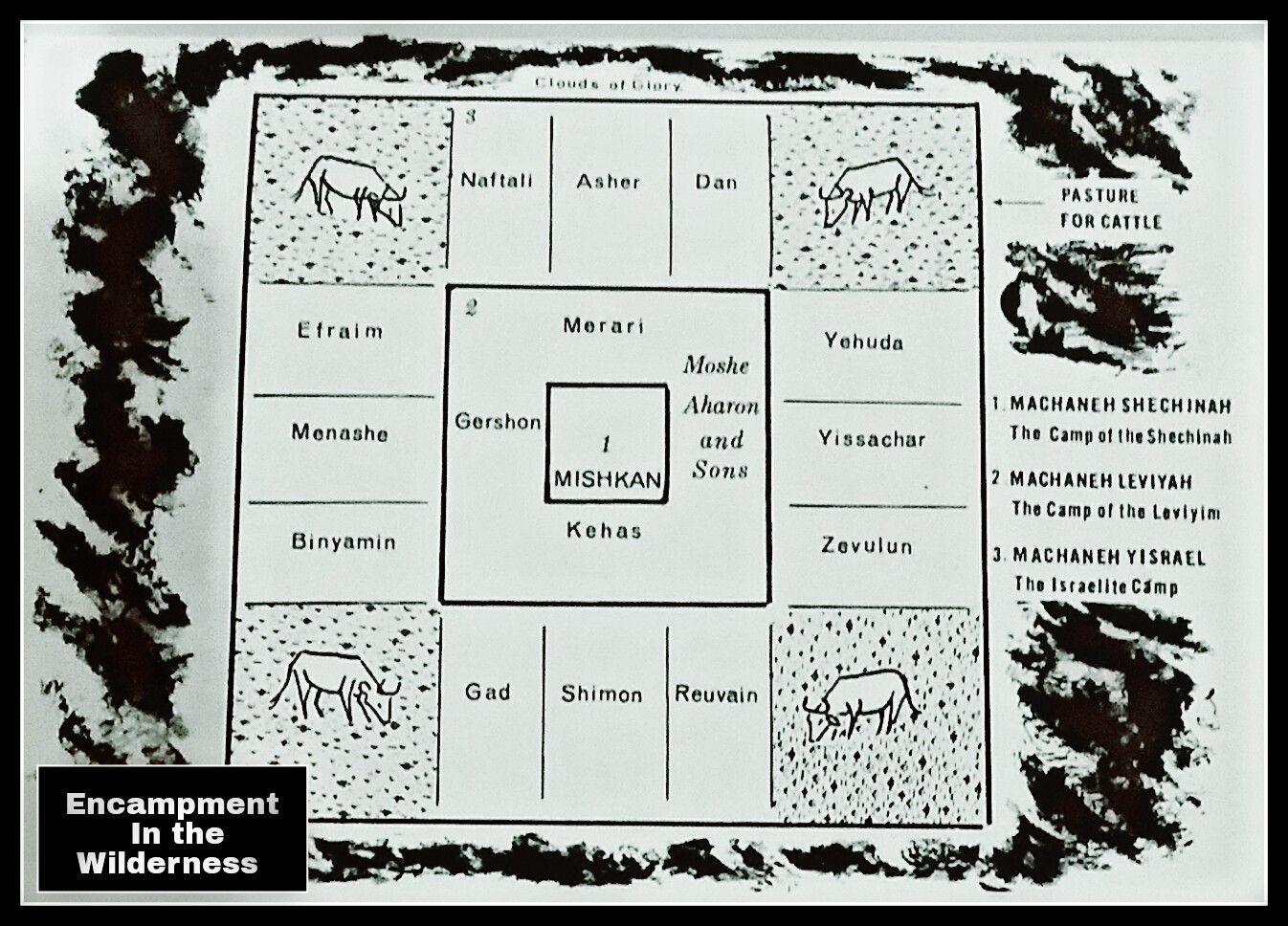
Being counted in this manner does have a military feel. Each of the Children of Israel counted were ready to battle for their beloved. Each tribe had a banner or standard in which they belonged to. We may not know which tribe we belong to today but all are welcome. Even those “grafted in” play a vital role to the community of believers
Learn your Torah my friends. Make it the center of your community. Uncertain of Torah, take a break to the wildernes yourself, renew your covenant with the Holy One. To stand alone in a community and be a part of it, one must raise a standard around Torah. Then the Holy One will dwell in you and in your household. The communities in which we dwell might come to recognize the blessings in your life and want to let G-d’s Word change them. The instructions are at your fingertips.
As we begin this fourth book of the Torah, be blessed, each and every day! Raise your banner! Happy day!
~Hallelujah Girl
Tags: #ReadYourBible #ItsAllAboutYeshua #TorahIsTruth, Bamidbar, Hebrew, Israel, Torah